
Please note: The content below may contain affiliate links. If you make a purchase through these links, we could earn a commission, at no additional cost to you.
In May 2025, we published a forecast asking a deceptively simple question: what would happen to CPU prices over the next 12 months?
The original article expected a relatively stable consumer CPU market, punctuated by new-product premiums and falling prices on older hardware. It also predicted continued AMD momentum, expensive X3D gaming processors, growing competition from Arm, increasing emphasis on AI hardware and the arrival of Intel’s Panther Lake around late 2025 or early 2026.
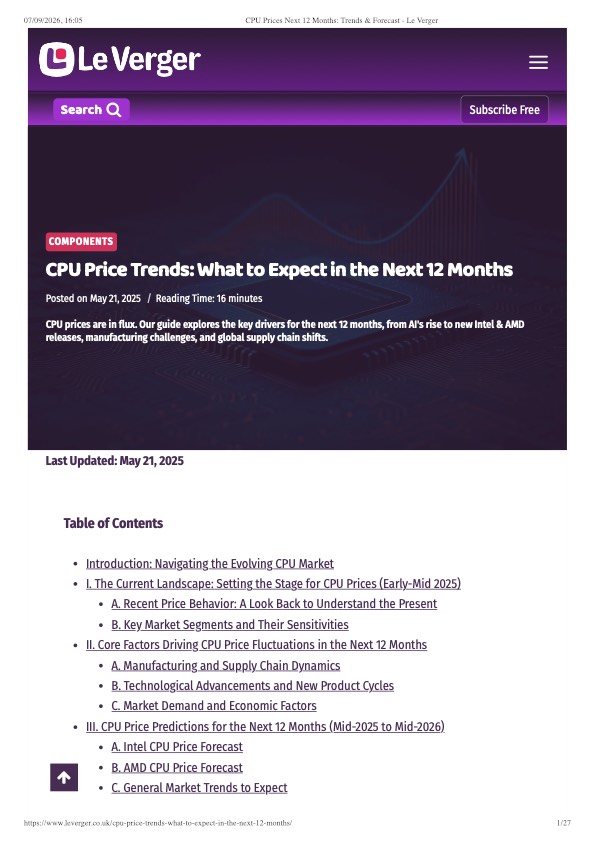
Read the original May 2025 forecast
For transparency, we’ve preserved the original article exactly as it appeared in May 2025. You can download the archived PDF here and compare our predictions with what actually happened.
Enough time has now passed to score those predictions properly. And the result is more interesting than simply declaring the forecast right or wrong.
We got much of the direction of the market right. Some of the timing was excellent. We also overestimated a couple of emerging trends, underestimated one enormous cost pressure, and — importantly — presented some already-known products as though they were more speculative than they really were.
So, before making another twelve-month forecast, here’s how the first one actually performed.
The short version: the market thesis was mostly right
Our broad prediction was that consumer CPUs themselves would not return to the extreme shortages or runaway pricing seen earlier in the decade. Instead, we expected competition between Intel and AMD to keep mainstream pricing under pressure, while new flagship products and specialist gaming chips remained expensive. Previous-generation processors would become increasingly attractive as retailers cleared inventory.
That proved to be a good description of what followed.
What we didn’t foresee nearly strongly enough was that the CPU could cease to be the biggest pricing problem in a PC build. Memory became the extraordinary story of 2026.
Prediction: Intel would be forced to compete aggressively on price
Verdict: right — and arguably understated.
The 2025 article expected Intel to face increasing pressure from AMD, particularly in enthusiast desktop PCs. We forecast aggressive promotions, previous-generation discounts and heavy competition in the mainstream Core i5/Core i7 price bands.
That competitive pressure became very real.
Intel followed Arrow Lake with the Core Ultra 200S Plus refresh in March 2026. The Core Ultra 5 250K Plus initially started at $199 and the Core Ultra 7 270K Plus at $299 — unusually aggressive pricing for processors aimed at enthusiast desktop systems. Intel subsequently revised its recommended prices upwards, illustrating that the market was not simply moving in one downward direction.
More importantly, AMD continued taking x86 share from Intel. Mercury Research data for Q2 2026 put AMD at a record 30.3% of x86 client CPU shipments, up from 23.9% a year earlier. Its desktop share reached 34.9%.
Our expectation that AMD’s gains would force Intel to become more aggressive was therefore sound.
Prediction: X3D processors would keep their gaming premium
Verdict: very right.
We specifically argued that AMD’s 3D V-Cache processors would continue commanding higher prices because their gaming performance gave AMD something buyers were willing to pay extra for. That characteristic of the market didn’t disappear. AMD’s Ryzen 7 9800X3D launched at $479, while higher-end X3D models stretched considerably further. AMD still lists the 9800X3D at $479, alongside newer enthusiast X3D products including the $499 9850X3D, $599 9900X3D and $699 9950X3D.
Rather than X3D becoming an ordinary feature that quickly lost its premium, it developed into one of AMD’s strongest product differentiators. That’s one of the cleaner hits in the original forecast.
Prediction: Panther Lake would arrive around late 2025 or early 2026
Verdict: almost exactly right.
The article expected Intel’s Panther Lake generation around late 2025 or early 2026 and correctly identified Intel 18A as the likely manufacturing technology. Intel formally revealed Panther Lake architecture in October 2025, describing it as the first client platform manufactured on Intel 18A. Core Ultra Series 3 processors then went on sale in January 2026.
That was a genuine forward-looking call, and the timing held up extremely well.
Prediction: AM5 would be the better long-lived platform
Verdict: right, but we underestimated AMD.
Our old article regarded AMD’s AM5 socket as a valuable upgrade path and expected support to continue into the Zen 6 era. AMD has since gone significantly further. At Computex 2026, the company extended its official commitment to support AM5 through 2029.
That makes the original advice to consider total platform longevity rather than CPU price alone look particularly good. It also strengthens the argument for AM5 when assessing today’s market.
Prediction: Zen 6 would become a 2026 consumer story
Verdict: timing miss.
This was our clearest conventional forecasting mistake. The article anticipated Zen 6 during 2026 and suggested that concrete specifications and early performance information could emerge during the forecast period. It also repeated speculation about as many as 24 cores on mainstream AM5 processors.
Zen 6 certainly exists in 2026: AMD’s next-generation EPYC “Venice” server processors are already ramping on TSMC’s 2nm process. But that isn’t the same thing as a retail Zen 6 Ryzen desktop launch. AMD’s public client roadmap now points towards its next-generation Medusa family as a 2027 development, while exact consumer desktop SKUs, clocks, core counts and prices remain unannounced.
We were right about the technology direction and wrong to imply that the consumer transition would arrive as early as it did.
Prediction: Windows on Arm could materially pressure Intel and AMD
Verdict: technically important, commercially overstated.
We expected Qualcomm’s Snapdragon X family to put pressure on x86 laptop pricing if Windows on Arm gained meaningful traction. Arm absolutely influenced the market.
Snapdragon helped force much greater attention onto battery life and performance-per-watt. Intel’s Lunar Lake and later Panther Lake products responded aggressively on efficiency, while AMD continued improving its mobile platforms. But Windows on Arm hasn’t yet transformed the notebook market.
TrendForce forecasts Windows-on-Arm AI notebooks at only around 3.2% penetration in 2026, up from 1.2% in 2025. That is meaningful growth, but nowhere near enough to say Arm has reset mainstream Windows CPU pricing.
The better prediction would have been: Arm would exert more influence on x86 processor design than its market share alone would suggest.
Prediction: buyers might pay an “AI premium”
Verdict: half right — but the real AI pricing effect happened somewhere else. Our article expected NPUs and “AI PC” positioning to become increasingly common and potentially increase average selling prices. AI hardware certainly became mainstream.
Intel, AMD and Qualcomm all now sell processors designed around substantial local AI acceleration, and TrendForce expects AI notebooks to account for 37.5% of notebooks during 2026.
But the consumer value proposition developed more slowly than the marketing. TrendForce itself notes that the market still lacks enough applications that clearly demonstrate the value of on-device AI at scale and create a compelling reason for ordinary consumers to upgrade.
Meanwhile, AI produced a huge pricing effect somewhere we hadn’t sufficiently anticipated: memory.
The story we missed: AI’s effect on DRAM
Our original article correctly told buyers to consider RAM and motherboard costs alongside the processor. But the scale of what happened to memory was well beyond our expectations.
AI-server demand encouraged manufacturers to prioritise higher-margin server and data-centre products. TrendForce reported conventional DRAM contract prices increasing approximately 93-98% quarter-on-quarter in Q1 2026 and forecast another 58–63% rise in Q2. By Q3 the pace was slowing, but DRAM prices were still expected to rise another 13–18%.
As of September 2026, TrendForce still describes supplier inventories as extremely low and incremental capacity as heavily weighted towards server demand. So we had the causal chain slightly wrong. We expected AI to make the processor itself more expensive. Instead, AI became one of the reasons the rest of the PC surrounding that processor became so costly.
That’s an important distinction.
Prediction: no repeat of the great CPU shortage
Verdict: broadly right, with one qualification.
We said another widespread, prolonged CPU shortage resembling 2020–2022 was unlikely. There was some CPU supply pressure in early 2026, particularly in notebooks, but availability improved significantly from Q2 onwards. TrendForce now says CPU supply has “markedly improved”, while memory and SSD costs remain the more persistent pressure.
So the forecast held.
Individual desirable processors can still become temporarily scarce, but there was no return to the market-wide CPU famine of the pandemic era.
One thing we wouldn’t publish the same way today
There is also an editorial issue worth acknowledging.
The May 2025 article discussed Arrow Lake as though it were largely forthcoming, saying it was “expected to be more widely available in early to mid-2025”. Arrow Lake desktop processors had already launched in October 2024.
Similarly, some of the Zen 5 discussion blurred the line between established products and future ones. That means a few apparently impressive forecasting calls benefited from information that was already available at the time.
The lesson is simple: a forecast should distinguish clearly between what has happened, what manufacturers have officially announced, what credible evidence suggests is likely and what we are actually predicting.
That’s the approach we’ll use from now on.
So how good was the 2025 CPU forecast?
The market direction was good.
We correctly anticipated:
We were too optimistic about the timing of consumer Zen 6, expected too much immediate commercial disruption from Windows on Arm and misunderstood where AI would exert its greatest pricing pressure. Most importantly, we learned that forecasting processor prices in isolation is becoming increasingly meaningless.
A £30 CPU saving does not help much when RAM, storage or a new motherboard adds £150 elsewhere. That changes the starting point for our next forecast. And that’s exactly what we’ve now done in our updated CPU Price Trends: What to Expect in the Next 12 Months guide.