
Please note: The content below may contain affiliate links. If you make a purchase through these links, we could earn a commission, at no additional cost to you.
Let’s be honest: the built-in speakers on your telly are probably rubbish. Even on expensive sets, the sound is often thin, tinny, and terrible for dialogue. Sonos has always been the gold-standard answer, but its price often puts it in the “aspirational” category.
Enter the Sonos Ray.
This is Sonos’s entry-level soundbar, promising to deliver that premium, room-filling sound and seamless streaming experience for under £200. It’s small, it’s sleek, and it’s aimed squarely at the millions of us with TVs in bedrooms, kitchens, or small living rooms that desperately need a bit of audio ‘oomph’.
But is it a real Sonos, or just a famous name on a compromised product? We’ve dug deep into the specs, performance, and real-world user experiences to find out if this is the budget sound upgrade you’ve been waiting for.
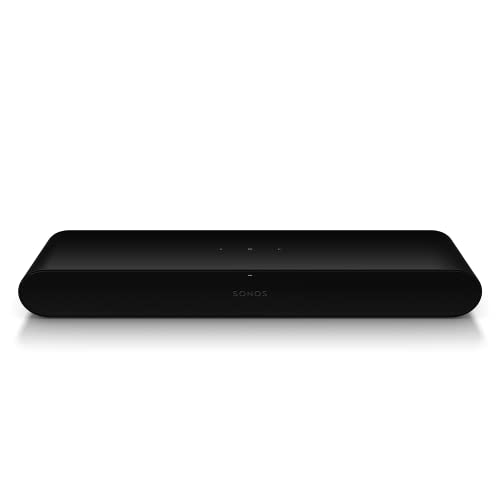
Sonos Ray Soundbar – All-in-one compact and sleek soundbar with Blockbuster sound for movies, gaming and wifi music streaming, compatible App and Apple…
CRYSTAL-CLEAR DIALOGUE: Features a special “Speech Enhancement” mode so you never miss a word.
SURPRISINGLY BIG SOUND: Delivers a rich, wide, and detailed soundstage that’s far bigger than its compact size.
PERFECT FOR SMALLER TVs: At only 55cm wide, it’s designed to fit perfectly under TVs from 32 to 43 inches.
STREAM EVERYTHING: Connects to your Wi-Fi for easy streaming from the Sonos app, Apple AirPlay 2, and more.
FLEXIBLE PLACEMENT: Clever forward-firing acoustics mean it sounds great even when tucked inside a media unit.
In Detail: The Small Bar with a Big Promise
On paper, the Sonos Ray is a simple proposition. It’s a compact (just 55cm wide), all-in-one soundbar designed to sit neatly on your TV stand. Sonos claims its “custom acoustics” and “proprietary anti-distortion technology” deliver rich, balanced audio that’s simply not possible from a small bar.
A key selling point is that all its acoustic bits face forwards. This isn’t just a technical detail; it means you can genuinely tuck it inside a media unit or on a shelf below your TV without the sound turning to mush.
It’s not just for TV, either. As a fully-fledged Sonos speaker, it connects to your Wi-Fi, allowing you to stream music, podcasts, and radio from the Sonos app, Apple AirPlay 2, and other services.
The big promise is “unboxing to unbelievable sound in minutes,” using just two cables. However, as we’ll see, that promise comes with one very large caveat that could be a deal-breaker for many.
Design and Build: Small and Smart
The first thing you notice about the Ray is its size. It’s tiny. At just 55cm wide, 9cm deep, and 7cm tall, it’s significantly smaller than most soundbars. This is its superpower.
We found numerous reports from users who bought it for this exact reason. One owner of a 32-inch LG TV was delighted, noting it “fits precisely mm perfect-between the TV’s legs.” For anyone with a smaller TV (say, 32 to 43 inches) on a stand, the Ray is one of the few soundbars that will slot in without looking ridiculous or blocking the screen.
The forward-firing acoustics are a genuinely clever design choice, giving you placement flexibility that upward- or side-firing bars just don’t have. You can pop it on a shelf, and it will sound just as good.
Sound Quality: Genuinely Bigger Than It Looks
So, does it sound any good? In short: yes, surprisingly so. For a speaker this small and (for Sonos) this cheap, it punches well above its weight.
We found this was the most common point of praise. One user, who was used to a full AV amp and a high-end Sonos Arc, bought the Ray for a second TV and was “quite stunned at the depth and volume this little box produces.”
It seems Sonos’s anti-distortion tech isn’t just marketing fluff. Users report it “packs a punch” and that the sound is “excellent” and “fantastic.” While it’s not going to rattle your windows, it delivers a wide, clear, and rich soundstage that is a massive leap from any built-in TV speaker.
Dialogue and Clarity: Its Secret Weapon
Where the Ray really shines is with dialogue. This is often the biggest complaint about TV audio—you’re constantly reaching for the remote to turn it up for speech and then quickly down for action scenes.
Sonos claims the Ray was “fine-tuned by award-winning Hollywood sound engineers” to ensure you never miss a word. Real-world experience seems to back this up. The Sonos app includes a “Speech Enhancement” feature that users rave about, saying it “add[s] depth and clarity” to voices.
One user described it perfectly, saying the soundbar “directs sound directly to the sofa.” If your main frustration is muffled, unclear dialogue, the Ray seems purpose-built to solve it.
The Connectivity Conundrum: No HDMI-ARC
Right, here it is. The big one. The Sonos Ray does not have an HDMI-ARC port.
It connects to your TV using an optical cable only.
For the non-nerds, HDMI-ARC is the modern standard that lets your TV and soundbar talk to each other. It means one remote controls everything (like volume) and it all just works.
The Ray’s optical-only connection is a deliberate cost-saving move, and it can be a right faff. The bar has no remote of its own. It’s supposed to learn your existing TV’s infrared (IR) remote. However, many modern remotes (like the included LG Magic remote) use Bluetooth or RF, not IR.
As one user found, getting their remote to “talk to the soundbar” required “more complicated interventions” and “searching and watching of videos on YouTube.” Another user was blunter: “Bear that in mind.”
This single omission is the Ray’s biggest weakness and a baffling one in 2025.
Setup and The Sonos App: A Mixed Bag
That connectivity issue bleeds directly into the setup experience. Sonos’s claim of “minutes” seems optimistic. The owner reviews out there suggest that “connectivity and setup experiences are mixed,” with some finding it “easy” while others report “connection issues” and find the “setup process overly complicated.”
The Sonos app itself is the only way to control features like Speech Enhancement, and it also gets “mixed reviews,” with some users reporting the “app is awful.” If you’re expecting Apple-like simplicity, you might be disappointed.
Bass and Surround: Manage Your Expectations
This is a single, compact bar. Let’s be real: it’s not a 5.1 cinema system. Users confirm that the “surround presence isn’t really there, it’s more of a wide soundstage.” This is perfectly fine—it’s creating a detailed stereo image, which is all you can ask at this size.
Bass is another area of compromise. While one reviewer felt the “bass extension is surprisingly low,” the more common sentiment is that it “needs to pair with [a] subwoofer for base to have effect.”
The good news is that, this being Sonos, you can add a Sub Mini and other speakers later. But on its own, the Ray is about clarity and width, not room-shaking rumble.
Sonos Ray vs. The Competition

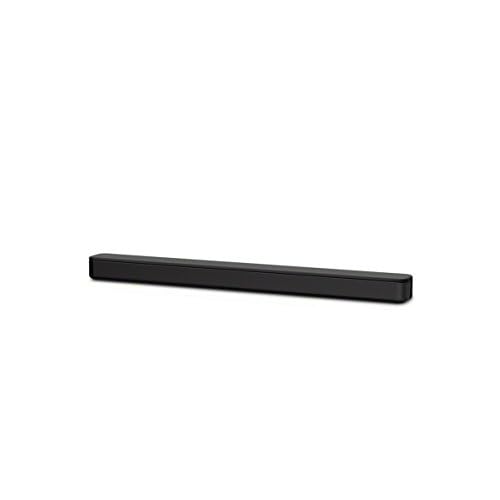


The most direct competitor listed is the Amazon Fire TV Soundbar Plus.
- Sonos Ray: A 2.0-channel bar focused on clarity, music streaming, and fitting into the wider Sonos ecosystem. Its strength is its compact size and clear dialogue. Its weakness is the optical-only port.
- Amazon Fire TV Soundbar Plus : This is a more expensive, but far more feature-rich, cinema-focused bar. It’s a 3.1-channel system (meaning it has a dedicated centre speaker just for dialogue) and supports premium formats like Dolby Atmos and DTS:X.
The verdict here is clear: If you want a simple, compact upgrade for a smaller TV and you value the Sonos multi-room music system, the Ray is a great-sounding choice (if you can live with the optical port). If your priority is cinematic, immersive sound with Dolby Atmos for your main living room, the Amazon Fire TV Soundbar Plus is technically a much more advanced system for £50 more.
Our Verdict
The Sonos Ray is a fantastic-sounding but deeply specific product. It is not the right soundbar for everyone, and it’s certainly not the best choice for a big, modern living room TV. As one user wisely put it, “I wouldn’t recommend as main tv or cinema setup.”
So, who is it for?
It’s the perfect solution for a secondary room. It’s for the 32-inch telly in the bedroom, the 43-inch one in the kitchen, or even, as one user noted, connected to a Mac Mini on a desk. It’s for anyone whose primary complaint is “I can’t hear the dialogue” and who has a smaller set.
It’s a brilliant “tinny TV” killer, delivering a sound that is richer, wider, and clearer than anything its size has a right to. But it’s held back from being an easy recommendation by a “tricky” setup and the baffling, unforgivable lack of an HDMI-ARC port.
If you can get it on sale (one user snagged it for £140) and you’re prepared for a bit of setup faff, it’s a brilliant audio upgrade.
Pros and Cons
Sonos Ray Pros:
Sonos Ray Cons:
Final Rating: 4.2 / 5
Additional Information
- Manufacturer: Sonos
- ASIN: B09ZYCBWYF
- Date First Available: 11 May 2022
- Dimensions: 9 x 55 x 7 cm
- Weight: 2 kg
- Connectivity: Wi-Fi, Optical
- Speaker Output: 120 Watts
Further Reading
- Sonos.com: Official Ray Product Page & Specs
- What Hi-Fi?: What is HDMI ARC and eARC?
- TechRadar: The Best Budget Soundbars 2025